A linear light is a simple product: an extruded aluminium profile, a diffuser, a row of LEDs and a cable at one end. The layout most manufacturers use — feed the strip from the end — is simple too. That simplicity is exactly where two problems come from, and both of them show up on site.
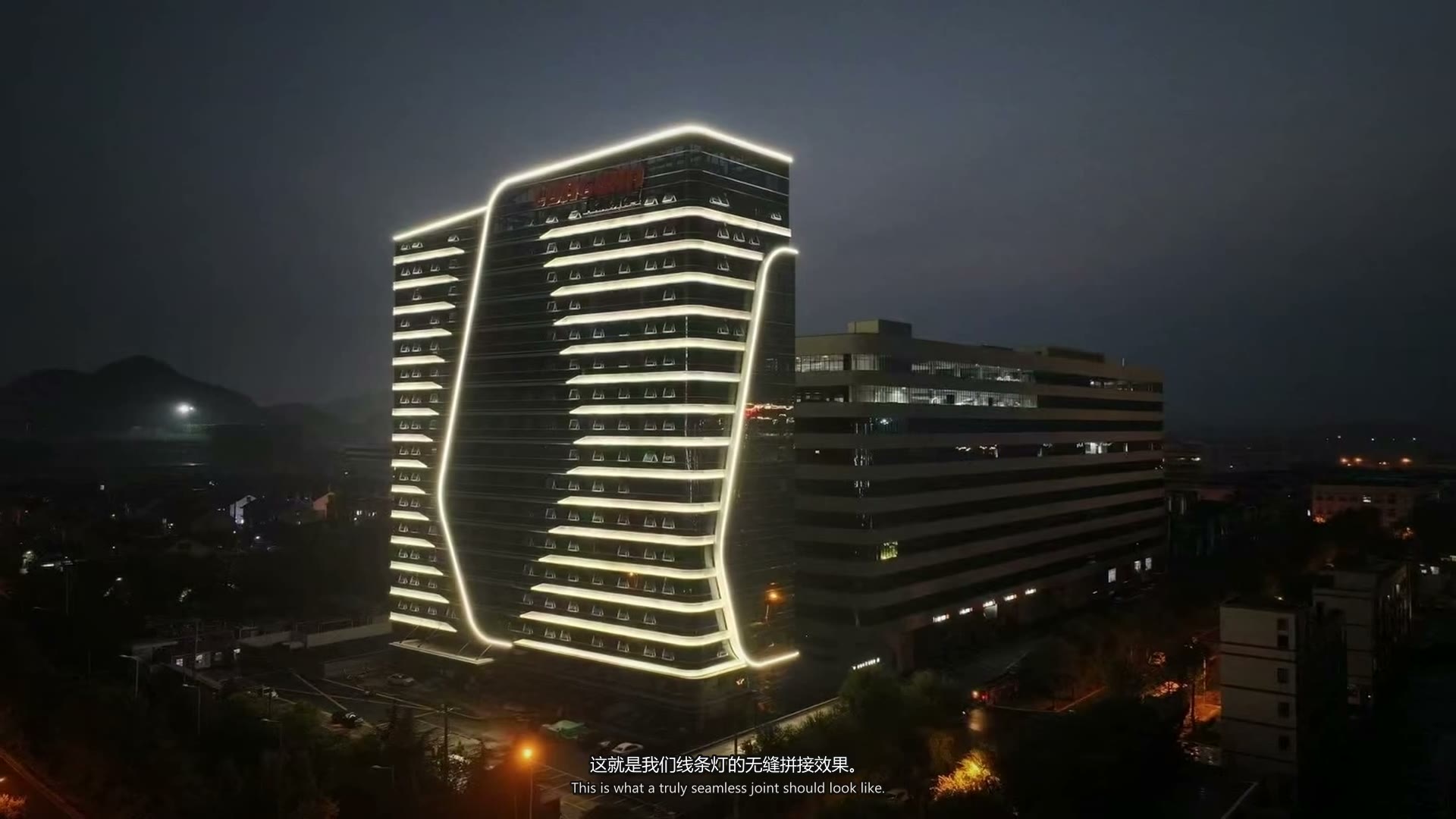
This film is shot on our own assembly line and on finished installations. It walks through both problems and the fix in the order a specifier meets them: how the current is routed, what happens where two lengths are joined, and what the result looks like once the joint works as intended.
What the video shows
The footage follows one strip from end to end. You see where the supply cable enters the profile, how the current is routed through the aluminium body, what is hidden inside a joint, and how the finished run looks once the joint is working.
Problem 1 — voltage drop past five metres
In an end-fed strip the current travels through every LED in the profile before it reaches the far end. The resistance of that path grows with length, so the voltage available at the end of the run falls below what the driver can hold. In practice a single feed is reliable to about five metres. Beyond that the far end dims, and on a mixed-colour run the colour shifts first — a run that should be white reads slightly pink or amber towards the end of the length.
The usual workaround is to feed from both ends. It halves the current path, but it also means two drivers, two terminations and two places where the IP seal has to be made good — on every single length in the installation.
Problem 2 — a dark gap at every joint
The second problem is simply visible. Where two lengths are joined, the profile has to stop: a short section at each end of the joint carries the connector and is not a light-emitting surface. On a dark facade at night this reads as a dark line cutting through the run. It is the most common complaint we receive from installers specifying continuous linear light, and it is the reason a row of ten identical fixtures does not look like one continuous line.
The seamless joint
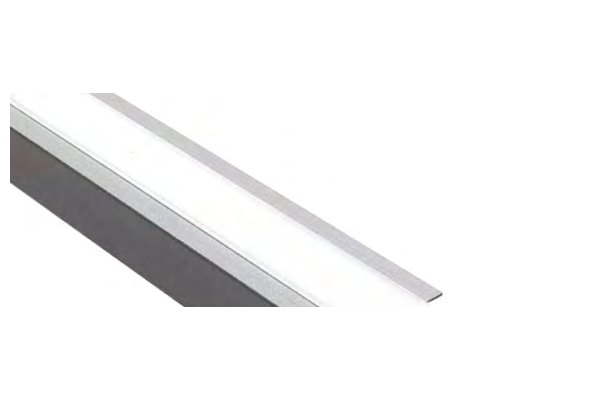
Our linear light uses a seamless end-to-end connection. The two profiles are butted together and the light-emitting surface continues across the joint, so there is no dead section to break the line. The installer gets a continuous run of light instead of a chain of segments, and the joint disappears into the run rather than punctuating it.
Mid-feed power: why the LED load stays low
This is the part that changes the numbers. Instead of feeding the strip from one end, our design takes the supply at the middle and feeds outwards in both directions. Two consequences follow.
First, the current path to any single LED is roughly half what it would be on an end-fed run of the same length. Each LED carries less current, runs cooler and degrades more slowly — a direct service-life benefit on a fixture that is expected to work outdoors for years.
Second, because the supply enters at the centre and the two halves run outwards, a cascade can be extended to ten metres from a single feed point without the voltage at the far end falling out of specification. Ten metres from one feed, instead of five from two.
Combined with the seamless joint, that gives long, continuous runs with no dark gaps and no voltage drop — which is what a facade, a bridge or a media wall actually needs.
Specification at a glance
- Colour — single colour, RGB, RGBW or RGBA with a dedicated amber channel
- Control — DMX512 / Art-Net, individual pixel addressing
- Supply — DC 24 V
- Cascade length — up to 10 m from a single feed point (mid-feed design)
- Joint — seamless end-to-end, no non-emitting section
- Protection — IP66 / IP67 / IP68 options
- Warranty — 3 years, 5 years on single colour
Where it matters
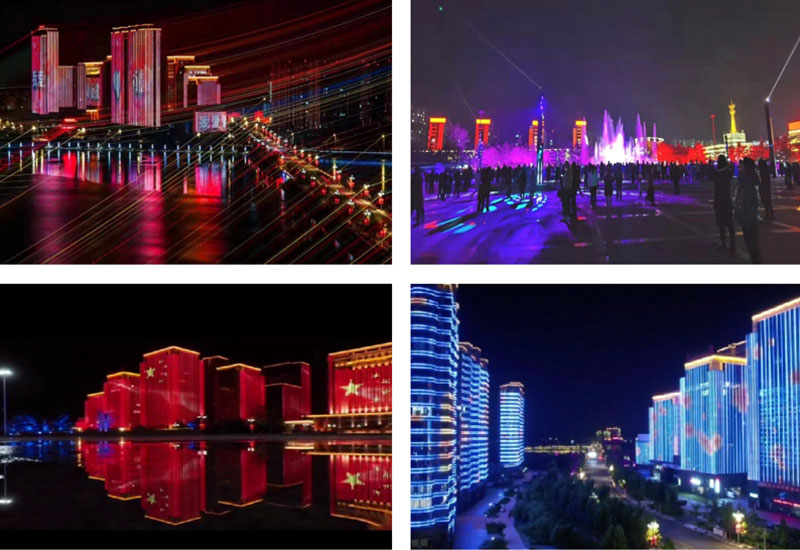
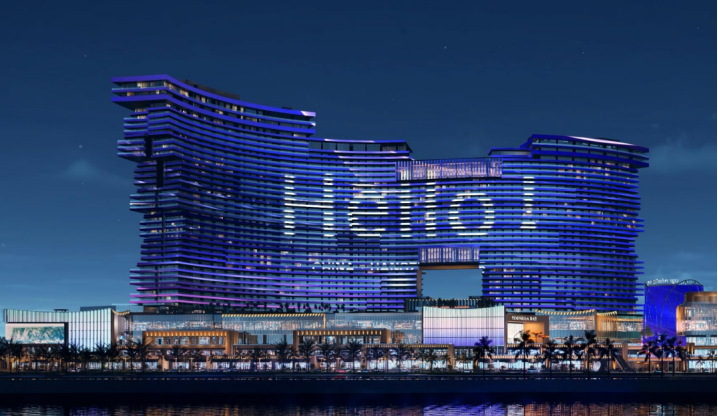
Anywhere a continuous run of light is the design intent: building facades and cornice lighting, media walls, bridge and tunnel lighting, retail coves, hotel lobbies and exhibition stands. The longer the run, the more the seamless joint and the mid-feed earn their place — because the alternative is more drivers, more terminations, more points of failure, and a visible dark line every few metres.
If you are specifying continuous linear light and need the joint detail, the wattage per metre and the control protocol, send us the drawings or a photo of a completed run. We will come back with a fixture layout proposal and a quotation within 24 hours.